Saturday, August 13, 2016

Happy Birthday, Hitch!


Sir Alfred Joseph Hitchcock, , (13 August 1899 – 29 April 1980) was an English film director and producer, at times referred to as "The Master of Suspense". He pioneered many elements of the suspense and psychological thriller genres. He had a successful career in British cinema with both silent films and early talkies and became renowned as England's best director. Hitchcock moved to Hollywood in 1939 and became a US citizen in 1955.
Over a career spanning more than half a century, Hitchcock fashioned for himself a recognisable directorial style. His stylistic trademarks include the use of camera movement that mimics a person's gaze, forcing viewers to engage in a form of voyeurism. In addition, he framed shots to maximise anxiety, fear, or empathy, and used innovative forms of film editing. His work often features fugitives on the run alongside "icy blonde" female characters.Many of Hitchcock's films have twist endings and thrilling plots featuring depictions of murder and other violence. Many of the mysteries, however, are used as decoys or "MacGuffins" that serve the films' themes and the psychological examinations of their characters. Hitchcock's films also borrow many themes from psychoanalysis and sometimes feature strong sexual overtones.

Hitchcock became a highly visible public figure through interviews, movie trailers, cameo appearances in his own films, and the ten years in which he hosted the television program Alfred Hitchcock Presents. In 1978, film critic John Russell Taylor described Hitchcock as "the most universally recognizable person in the world", and "a straightforward middle-class Englishman who just happened to be an artistic genius."

Hitchcock directed more than fifty feature films in a career spanning six decades and is often regarded as the greatest British filmmaker. He came first in a 2007 poll of film critics in Britain's Daily Telegraph, which said: "Unquestionably the greatest filmmaker to emerge from these islands, Hitchcock did more than any director to shape modern cinema, which would be utterly different without him. His flair was for narrative, cruelly withholding crucial information (from his characters and from viewers) and engaging the emotions of the audience like no one else." Prior to 1980 there had long been talk of Hitchcock being Knighted for his contribution to film. Critic Roger Ebert wrote: "Other British directors like Sir Carol Reed and Sir Charlie Chaplin were knighted years ago, while Hitchcock, universally considered by film students to be one of the greatest filmmakers of all time, was passed over". Hitchcock was later to receive his knighthood from Queen Elizabeth II in the 1980 New Year Honours. In 2002, the magazine Movie Maker named Hitchcock the most influential filmmaker of all time.

... now, go make something beautiful!
¸.•´¸.•*´¨) ¸.•*´¨)(¸.•´ 
(¸.•´♥ Tristan
 
Robert Cummings and Grace Kelly in 1954's "Dial M for Murder"
 

Monday, August 1, 2016

Meet Cora Pearl ...

Cora Pearl  was a 19th-century courtesan of the French demimonde who enjoyed her greatest celebrity during the period of the Second French Empire.Working as a street prostitute, she made a connection with a procurer, a “Monsieur Roubisse,” who set her up in more suitable quarters, taught her the business rudiments of her new trade and tutored her in refining and broadening her repertoire of professional skills. After six years, she despaired of ever freeing herself from his all-encompassing influence. However, fate stepped in, the procurer died of a heart attack, liberating Emma.
 Cora Pearl (1835 - 1886)
Her first lover of distinction was the multi-titled, twenty-five-year-old Victor Masséna, third Duke du Rivoli, and later fifth Prince of Essling. He set her up in opulence, showering her with money, jewels, servants and a private chef. He provided her with funds for gambling when she visited the casinos and racecourse in the fashionable resort of Baden, Germany. He bought her the first horse she ever owned, and she became an accomplished equestrienne; it was said “she rode like an Amazon” and “was kinder to her horses than her lovers.” Her liaison with Masséna lasted five years. While cultivating Masséna, she was simultaneously sharing her favors with Prince Achille Murat, a man much older than Masséna.

By 1860, Pearl was one of the most celebrated courtesans in Paris. She was the mistress of notable aristocrats, the Prince of Orange, heir to the throne of the Netherlands, Ludovic, Duc de Grammont-Caderousse, and more significantly Charles Duc de Morny, who was the half-brother of the Emperor Napoleon III. The Emperor’s brother generously contributed to the opulent life Pearl demanded.
 In 1864, Pearl rented a chateau in the region of the Loiret. Known as the Chateau de Beauséjour (“beautiful sojourn”), it was a luxuriously appointed residence of stained glass windows, costly decorations and immaculately maintained interiors and grounds. Her boudoir boasted a custom-made bronze bathtub monogrammed with her intertwined initials. The château was conceived for gala entertainments. There were rarely fewer than fifteen guests at the dinner table, and the chef was instructed to spare no cost on the expenditure for food. Pearl was known for devising entertainments of an unexpected and outrageous theatricality, of which she invariably was the star attraction. On one such evening, she dared the group assembled around the dinner table “to cut into the next dish” about to be served. The meal’s next course was Cora Pearl herself, presented lying naked on a huge silver platter, sprinkled with parsley, and carried in by four large men.
Her most dedicated benefactor and enduring admirer was Napoléon Joseph Charles Paul Bonaparte, the Emperor’s distinguished cousin. She met the extremely wealthy prince in 1868 when he was forty-two years old. Their liaison lasted nine years, the longest relationship in Pearl’s career. He bought her several homes, one a veritable palace: “les Petites Tuileries.”

In 1860, Pearl made an appearance at a masquerade ball attended by the elite of Parisian society. She caused a sensation as a scantily costumed Eve, whose degree of nudity diverged little from the biblical original. Invariably enthusiastic about exhibiting her physical charms to an audience, she took the role of a singing Cupid in the Jacques Offenbach operetta Orphée aux Enfers, (Orpheus in the Underworld) performed at the Theatre Bouffes-Parisien in 1867. It was written that “Cora Pearl made an appearance half-naked on the stage. That evening the Jockey Club in its entirety, graced the theatre. All the names…of French nobility were there…It was a success of a kind…” The chronicle of the evening continued, “Apparently the beautiful Cora Pearl had already munched up a brochette (“skewer”) of five or six historical fortunes with her pretty white teeth.
 Cora Pearl and  Prince Achille Murat(1865)
The high point of Pearl’s career as courtesan were the years 1865-1870. In his biography of Pearl, The Pearl From Plymouth (1950), author W. H. Holden writes that there is evidence that Pearl regularly sent money to both her mother in England and father in America. For Cora Pearl, money was for spending, for accumulating the luxuries of life and buying her way to a coveted perch in the upper echelons of society. Her jewel collection alone was valued at some one million francs; at one point, she owned three homes, and her clothing was made for her by the renowned couturier Charles Frederick Worth. As her career prospered, the gifts from her suitors needed to be both costly and imaginative. She pitted her admirers against one other, raising the price for her favors as the game between competitors escalated. In her heyday, she was able to command as much as ten thousand francs for an evening with her.
 ...and we think celebrities are scandalous today!

Thanks for visiting Enchanted Revelries and spending a few minutes with Cora Pearl and myself ...

now, go make something beautiful!
¸.•´¸.•*´¨) ¸.•*´¨)(¸.•´ 
(¸.•´♥ Tristan
 (Special Thanks to The Vintage News)

Saturday, July 16, 2016

El Ateneo Grand Splendid - Wow!

I know it's been so long since I posted here! I've been busy having surgery and recovering ... yes, I'm fine ... but when I discovered this wonderful, exquisite bookstore via my friend and sharer-of-all-things-spectacular, Shirley, I knew I had to share it with you!

Just a reminder - click on any photo and will magically grow for you!
Tucked away in Barrio Norte, Buenos Aires is a beautiful bookshop called El Ateneo Grand Splendid. It is built within the almost 100-year-old Grand Splendid Theater, which opened in 1919.
The theatre was later converted into a cinema and eventually, in 2000, it was converted into the El Ateneo Grand Splendid bookshop, which currently welcomes over one million visitors each year.
The stunning building was originally designed by architects Peró and Torres Armengol, then later converted from a cinema into a bookshop by architect Fernando Manzone, who retained many parts of the theatre, including the stage, the balconies, the incredible architectural details and even the red curtains.
 In 2008 El Ateneo Grand Splendid was named the second most beautiful bookshop in the world by The Guardian, and that’s no surprise considering it’s elaborate décor and classic 1920’s theater feel.


 According to a recent study by the World Cities Culture Forum, Buenos Aires has more bookshops per inhabitant than any other city in the world. With a population of around 2.8 million, Buenos Aires has at least 734 bookstores – roughly 25 bookshops for every 100,000 inhabitants. Worldwide, only Hong Kong comes close, with 22 bookshops per 100,000, followed by Madrid in a distant third with just 16 and compared to a mere 10 bookshops for every 100,000 for London. Sadly, America isn't even on the list.
You can find out more about this fantastic bookstore at their official website.

Thanks for visiting Enchanted Revelries today - it's good to be back in the writer's chair! And thanks to Shirley for introducing me to El Ateneo!

...now, go make something beautiful!
¸.•´¸.•*´¨) ¸.•*´¨)(¸.•´ 
(¸.•´♥ Tristan


Tuesday, June 21, 2016

Let Me Introduce Rob Heard ...

After his first job in a sheet metal factory left him somewhat cold and uninspired, Rob Heard headed into the woods of Somerset at just 18 years old, to get down to the macho business of tree-felling and a return to nature.

Rob has been a man of the woods ever since, averse to keyboard and pen, at one with chainsaw and chisel – living out a lifelong affinity with timber borne during a childhood where he accompanied his father, a crafter of cricket bats, on his forays to harvest willow.


Outdoor pirate ship playground
 
This career path gradually evolved into building timber playgrounds for children - where Rob became renowned for his trademark pirate ships. During the planning process of each playground project, he developed small-scale working models for his clients to illustrate how the finished play equipment would fit together. Rob found that these models were often ‘lost’ by his clients, whose children no doubt fell in love with these apparent 'toys' and squirreled them away to their bedrooms.
Indoor pirate ship playground

Unexpected inspiration followed when, after injuring his wrist, Rob was forced to stop lugging tree trunks and spent six months recovering from the surgery at home. During this time, he scaled down his focus and began to think big, yet in miniature, creating his first Bough House sculpture for his three young daughters. He has been creating these intricate yet robust pieces ever since.

My only limit is the height of my workshop ceiling and maybe that’s a blessing!”
 

“Once I start creating, I do not know where the structure will end.”  

The wooden sculptures take shape in a music-filled workshop at the bottom of Rob's garden. Each one can take up to four or five hundred hours to complete, including time spent just sitting and staring at the pieces, musing about how they are going to develop.

Inspiration usually starts with a bough of wood - cut from local trees or found lying in the fields close to Rob's home. The form follows the shape and twists of the branch, informing the design. There may be sketches, but no rigid plans and the Bough Houses develop from a sense of how Rob wants the journey within that sculpture to feel, or the way in which he would like one to be able to travel between different areas within the form.


The individual elements of the sculptures are hand cut or carved and fixed using pins and glue - right down to the last roof tile. Rob's attention to detail and meticulously accomplished workmanship mean that the structures are deceptively robust. They are not delicate, they are meant to be played with and are as strong as they are beautiful. 


In effect these are the real deal, not models, but real on a very unusual scale. Rob's children love to play with the Bough House that he built for them and the quality of workmanship has stood the test of time - but they are more than a physical thing - you can spend hours wandering the walkways and turrets and paths in your own mind. These are truly inspirational pieces of art. 

Each of Rob Heard's wooden Bough House sculptures takes several months to complete. Every intricate spiral staircase, walkway and ladder leads somewhere...inviting the imagination on a miniature exploration through an array of turrets and towers.

The sculptures can be over six feet tall and each one is completely unique, taking inspiration from the wood and the surrounding Somerset countryside.

 Follow Rob on Twitter to see how the latest sculpture is evolving.


Thanks for visiting Enchanted Revelries ... now go make something beautiful!

¸.•´¸.•*´¨) ¸.•*´¨)(¸.•´ 
(¸.•´♥ Tristan


Wednesday, June 1, 2016

Creating Miniature Shrines for ATC's (Artist Trading Cards) ...


When I first discovered ATC's (Artist Trading Cards) about 10-12 years ago, I jumped in head first and joined every swap I could find; the result being that I have hundreds of marvelous little works of art from some terrific artists and craft people. There has always been a question of what to do with them once you've got them! I had a couple of my favorites framed - but that gets expensive in no time flat - AND you can't have hundreds of little tiny frames on a wall; it looks like you have roaches - AND the frames don't really do them justice.

So this month when my design team kit arrived, I was excited to find these little ATC shrine boxes, especially designed to hold Artist Trading Cards (which are ALWAYS 2 1/2" x 3 1/2" - the only "rules!").

I chose a shrine kit to use:  ATC Shrine with Feet
Then I created an ATC to use in the shrine:

I used left over pieces from my Enchanted Forest Castle and Mini Album Project (here) paper pack and covered the shrine with pieces of paper after it was glued together. (Tip: I used rubber bands to hold the shrine square while the glue was drying - worked great!)
Then I used the Gold Leaf Adhesive Pen with Gold Leaf for the edges of the shrine, a piece of gold zig zag Dresden border inked with Mermaid alcohol ink, miniature blue rose buds, and pieces of the Leafy Corners chipboard set
I added Peacock Liquid Pearls and a Round Word Charm. All are from Alpha Stamps. I finished up with a crown die cut from my stash, cut a die cut chipboard frame in half from my stash (sprinkled with micro beads colored with alcohol ink from Alpha Stamps) and glued them to my finished piece.

Now I thought the ATC was properly showcased!

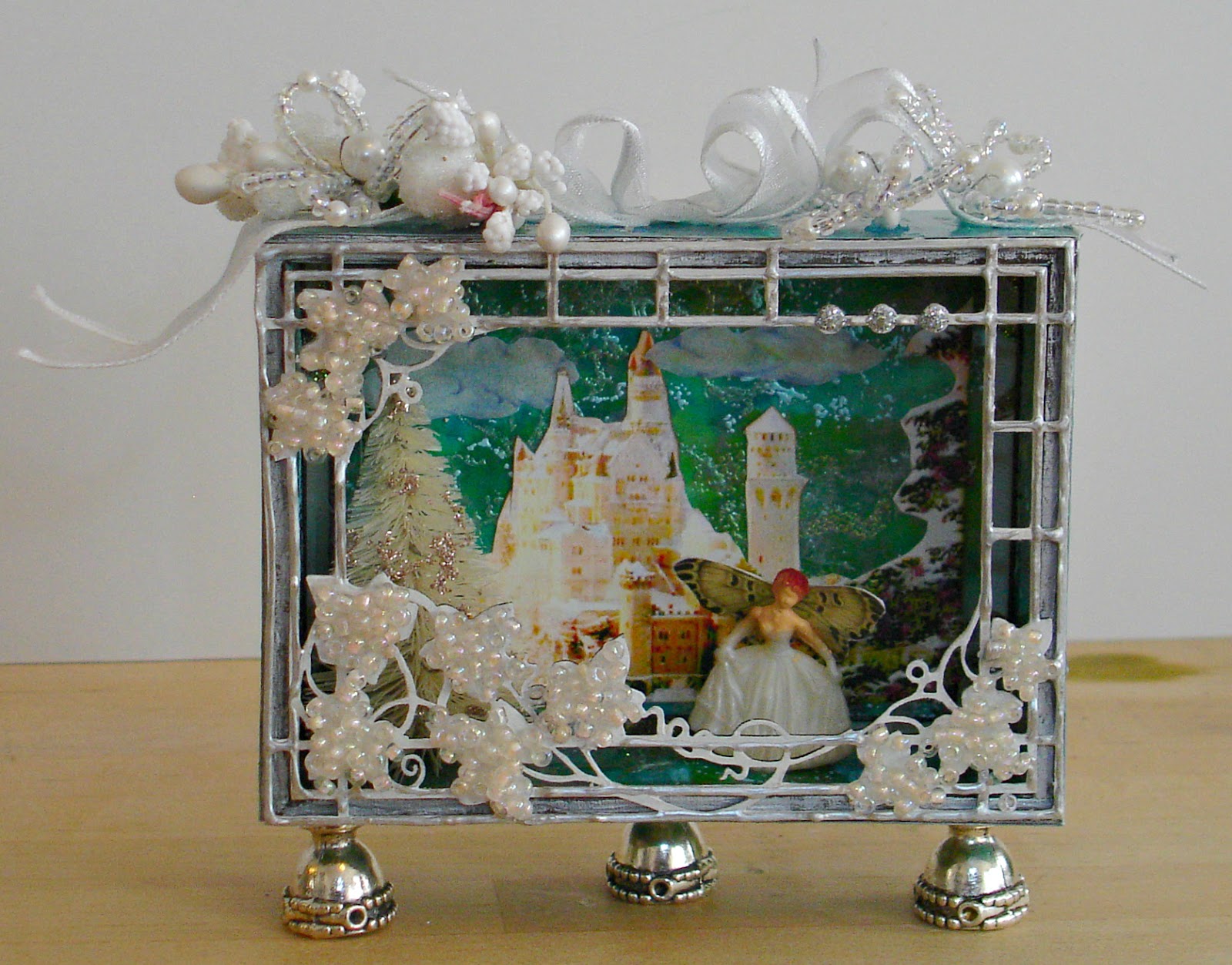
Just as I was getting started on the second piece, I got a phone call from a friend who wanted suggestions for her wedding's bridal party's place setting favors. I mentioned what she I was in the middle of doing right now and asked what her theme was...well, it seems that she's getting married at Christmastime and her theme is Enchanted Winter Wonderland. Sound pretty, huh?! I told her to give me two days, and I'd come up with an idea (I didn't mention I was also going to fulfill my design team obligation!).

First I had to create the base of the shrine: the ATC:
I used alcohol inks and embossing powders to create the background, used and image from the "Castles in the Air" collage sheet, and painted in the clouds myself. I decided it looked wintry enough. Hard to remember when it's 90 degrees outside!

Then I chose to use the shrine kit "ATC Shrine Box"

adding the "ATC Ivy Frame." I covered the leaves with 1mm micro beads, used platinum Liquid Pearls to outline all the straight edges and platinum Stickles for the three
decorative dots on the insert. It was getting more enchanted! I used the middle sized bottle brush tree from the Retro Bottle Brush Tree Set (shaving some of the back branches so it would fit totally into the box flush with the back...also Flower Soft was added to the tree image on the right side for texture. I also added a pair of wings from the Butterflies Decoupage Paper (I love this paper!) to a vintage plastic bride from my stash. I assembled all the various elements, added Silver Cups turned upside down to use as feet and ribbons and bead flowers and millinery flowers buds to the top to finish it up.
My friend was thrilled with it - and asked if I cold make 9 of them - and somehow turn them into placecards.

I'll let you know how that turns out LOL.

If you'd like to try these projects yourself, here is the complete Alpha Stamps supply list: just click here for all the materials and information on each.

Now...go make something beautiful!
¸.•´¸.•*´¨) ¸.•*´¨)(¸.•´ 
(¸.•´♥ Tristan